
Top 10 Dermal Filler Brands in 2027: Juvederm vs Restylane vs Teosyal vs Belotero vs Stylage vs Revolax

Choosing a dermal filler in 2027 is no longer simply a question of “Which brand is best?” Juvéderm®, Restylane®, Teosyal®, Belotero®, Stylage®, Revolax® and other established filler families contain multiple formulations designed for different tissues, depths and treatment goals. A product that may be considered for lip contouring is not necessarily the product a clinician would choose for cheek support, deeper folds or another area of the face. For patients comparing dermal fillers in Dubai, understanding these differences—and the limitations and risks of injectable treatment—is considerably more useful than following a brand ranking.
Medically reviewed by Dr. Farshad Zadeh, MD – Medical Director & Aesthetic Medicine Expert
Last medically reviewed: October 6, 2026
Key points
Most of the major filler families discussed in this guide are based primarily on hyaluronic acid (HA), a substance naturally present in human tissues.
A filler brand is not a single product. Juvéderm, Restylane, Teosyal, Belotero and other ranges contain different gels with different physical characteristics and intended uses.
There is no high-quality evidence proving that one filler brand is universally superior to all others.
How a filler behaves depends on more than its brand name: HA concentration, cross-linking, gel structure, rheological properties, injection depth, anatomical location and injection technique all matter.
Results and duration vary considerably between products, facial areas and individuals.
Dermal fillers are medical procedures. Rare but serious complications can occur, including inadvertent injection into a blood vessel, which can cause tissue necrosis, visual impairment or blindness, and stroke.
Product availability, registration and permitted indications vary by country. Patients seeking dermal fillers in Dubai should have the exact product and proposed treatment assessed within the current UAE regulatory framework.
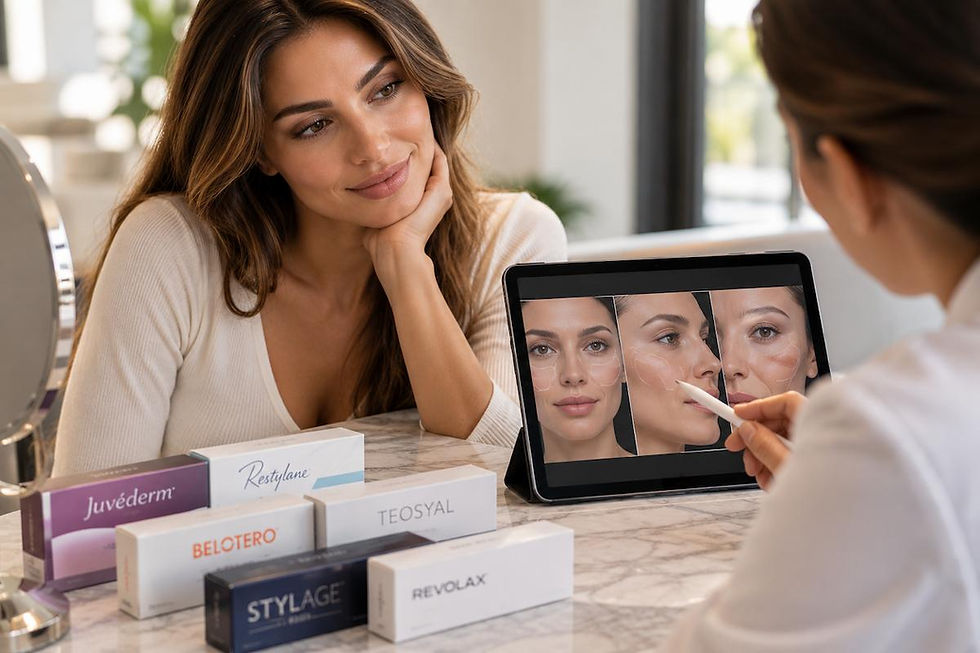
What Exactly Is a Dermal Filler?
Dermal fillers are injectable materials used to add or restore volume, alter contours, soften certain folds or wrinkles, and address specific aesthetic concerns.
The category includes several materials, but hyaluronic acid fillers dominate contemporary facial aesthetics.
HA is naturally found in the body, including in skin and connective tissue. In an injectable filler, however, HA is manufactured and formulated into a gel. Manufacturers modify characteristics of that gel—including the way HA molecules are cross-linked—to create products that behave differently after injection.
This explains why asking whether “Juvéderm or Restylane is better” is often too broad a question.
A clinician may want a different gel characteristic for subtle lip contouring than for structural cheek augmentation. Highly mobile areas of the face also behave differently from relatively static areas.
Recent research reinforces this point. A 2026 systematic review of long-term facial HA filler durability included 24 studies and 1,410 patients and found that longevity was influenced by manufacturing technology, tissue mobility and anatomical factors. In other words, duration cannot reliably be predicted from the brand name alone.
Top 10 Dermal Filler Brands to Know in 2027
The following list is not a ranking from best to worst. It introduces 10 major filler families patients may encounter internationally and explains what distinguishes them.
1. Juvéderm®
Juvéderm is one of the world's best-known hyaluronic acid filler families and is produced by Allergan Aesthetics, an AbbVie company.
Importantly, Juvéderm is not one filler.
The portfolio includes multiple formulations developed for different treatment areas and purposes. Depending on the market, names may include products from the Voluma, Volift/Vollure, Volbella and Ultra families, among others.
In the United States, Allergan's current Juvéderm collection includes six FDA-approved HA fillers covering seven facial treatment areas. The manufacturer reports that duration can range from approximately one to two years depending on the specific product and area treated.
Those figures should not be generalized to every Juvéderm formulation worldwide or every patient.
What distinguishes Juvéderm?
Different Juvéderm families use specific HA manufacturing technologies to create gels with different properties. Some formulations are intended to provide greater structural support, while others are designed for areas where softer integration or movement may be desirable.
For patients searching Juvéderm Dubai, the useful question is therefore not simply “Do you use Juvéderm?” but:
Which Juvéderm product is being recommended, for which anatomical area, and why?
2. Restylane®
Restylane, from Galderma, is another long-established HA filler family with a large international clinical footprint.
Like Juvéderm, it is a portfolio rather than one universal injectable.
Galderma describes its current Restylane range as incorporating several HA technologies designed to create different characteristics for contouring, definition, movement and skin-related applications.
Products available internationally may include Restylane Lyft, Defyne, Refyne, Kysse and Volyme, among others, although exact portfolios and indications vary by country.
Restylane vs Juvéderm: which is better?
This is probably the most common dermal-filler comparison—and there is no universal winner.
Both families contain multiple HA gels. Comparing “Restylane vs Juvéderm” without specifying the exact products and treatment area is therefore a little like comparing two car manufacturers without specifying the models.
The more clinically relevant comparison is between specific formulations intended for a specific indication.
A patient's facial anatomy, tissue characteristics, previous filler history and desired degree of projection or movement may all influence product selection.
3. Teosyal®
Teosyal is manufactured by Swiss company Teoxane and includes the well-known Teosyal RHA® range.
RHA stands for Resilient Hyaluronic Acid. Teoxane's range includes formulations with different properties for superficial wrinkles, deeper folds, lips and facial volume.
The company's current product information lists, among others, RHA 1, RHA 2, RHA 3, RHA 4 and RHA Kiss, as well as products from its PureSense range.
One interesting development going into 2027 is the continued evolution of the RHA portfolio. In January 2026, the FDA approved RHA Dynamic Volume for cheek augmentation and correction of age-related midface contour deficiencies in adults aged 22 or older in the United States.
Why is Teosyal often discussed for dynamic areas?
The RHA range was developed around maintaining gel characteristics in areas exposed to facial movement.
That does not mean every Teosyal product is appropriate for every mobile facial area—or that RHA technology has been proven superior to every competing technology.
Again, the exact formulation matters.
4. Belotero®
Belotero is a hyaluronic acid filler family associated with Merz Aesthetics.
Its portfolio includes formulations with different physical characteristics intended for different depths and aesthetic objectives.
Belotero is often encountered in discussions about fine lines, facial folds, lip treatment and volume correction, but patients should avoid assuming that every product carrying the Belotero name has the same indication or behaves identically.
Belotero vs Juvéderm vs Restylane
The clinically meaningful differences lie in the individual gel formulations, not simply the logos on their packaging.
When a practitioner chooses between these families, considerations may include tissue depth, mobility, desired projection, integration and the approved/intended use of the exact product.
5. Stylage®
Stylage is manufactured by French company Laboratoires VIVACY and has been available in aesthetic medicine since 2008.
The Stylage portfolio contains several HA products covering different treatment objectives, including wrinkle correction, volume restoration and hydration-related applications.
VIVACY describes its fillers as using its IPN-Like cross-linking technology. Depending on the market, the range includes formulations such as Stylage S, M, L, XL and other specialized products.
Some Stylage formulations also incorporate mannitol, although composition should always be checked for the exact product rather than generalized across the entire range.
Stylage vs Juvéderm
Neither brand can reasonably be called better in isolation.
Both offer multiple HA gels, and appropriate selection depends on the indication and the characteristics required from the product.
6. Revolax®
Revolax is a South Korean hyaluronic acid filler brand that has gained substantial visibility in several international aesthetic markets.
Its commonly encountered range includes products designed with different gel characteristics for different depths and treatment objectives.
Revolax is frequently compared online with established European and US filler brands, particularly in discussions about lip augmentation and facial contouring.
However, price, social-media popularity or country of manufacture should not be used as proxies for clinical suitability.
When considering Revolax—or any imported dermal filler in Dubai—patients should ask about the exact formulation, current UAE regulatory status, intended use, traceability and why the practitioner considers it appropriate for their anatomy.
7. Aliaxin®
Aliaxin is an Italian hyaluronic acid filler family from IBSA, a company also known within aesthetic medicine for other injectable HA technologies.
The Aliaxin range includes different formulations intended to address different facial requirements, from contour and volume to more superficial applications.
As with competing ranges, the important distinction is not simply “Aliaxin filler,” but the exact product selected.
Patients comparing Aliaxin vs Juvéderm or Restylane should therefore focus on the proposed indication, formulation and evidence rather than assuming all HA gels are equivalent.
8. Perfectha®
Perfectha is a hyaluronic acid dermal filler family associated with Sinclair.
Different products within the range are designed for different injection depths and aesthetic applications.
It is another example of why the modern filler market cannot be reduced to one “best” gel: manufacturers create portfolios precisely because different facial tissues and treatment objectives require different material characteristics.
9. Neuramis®
Neuramis is a South Korean HA filler family manufactured by Medytox.
Korean aesthetic products have become increasingly visible internationally, and Neuramis is one of the HA brands patients may encounter when researching dermal fillers.
As with Revolax, international availability does not establish a product's regulatory status or indication in the UAE.
Patients should verify the exact product rather than relying on broad online descriptions of the brand.
10. Saypha®
Saypha is an HA filler range from Croma-Pharma, an Austrian company active in minimally invasive aesthetic medicine.
The family includes different formulations intended for varying degrees of wrinkle correction, contouring and volume.
Saypha is less familiar to some patients than Juvéderm or Restylane, but illustrates the increasingly international nature of the dermal filler market entering 2027.
Juvéderm vs Restylane vs Teosyal vs Belotero vs Stylage vs Revolax: Quick Comparison
Main material | What patients should know | |
Juvéderm | Hyaluronic acid | Large portfolio with formulations for different facial areas and objectives |
Restylane | Hyaluronic acid | Long-established family using several HA technologies across different formulations |
Teosyal | Hyaluronic acid | Includes the RHA range developed with facial movement in mind |
Belotero | Hyaluronic acid | Multiple formulations designed for different tissue depths and objectives |
Stylage | Hyaluronic acid | French HA portfolio using IPN-Like technology; composition varies by product |
Revolax | Hyaluronic acid | South Korean filler family with formulations for different treatment depths |
Aliaxin | Hyaluronic acid | Italian HA range with multiple products for different facial applications |
Perfectha | Hyaluronic acid | HA portfolio with formulations intended for different depths and corrections |
Neuramis | Hyaluronic acid | South Korean HA filler family |
Saypha | Hyaluronic acid | Austrian HA filler portfolio with different formulations and applications |
Important: This table describes product families, not equivalence between individual products. Availability, indications and regulatory status differ between countries.
Which Dermal Filler Is Best for Lips?
There is no single HA filler proven to be best for every pair of lips.
Lip treatment can involve very different objectives: restoring age-related volume, defining the vermilion border, adjusting proportion, addressing asymmetry or adding fullness.
Lip anatomy, existing volume, tissue characteristics and previous filler all matter.
Evidence for HA lip fillers is substantial but not perfect. A 2026 systematic review and meta-analysis of randomized controlled trials found moderate-to-high overall efficacy and patient satisfaction. It also found that temporary treatment-related reactions were common, particularly swelling, firmness, bruising and tenderness.
This is a useful reminder that “minimally invasive” does not mean “no medical risk.”
Which Filler Is Best for Cheeks and Midface Volume?
Again, the answer is formulation-specific.
A clinician treating age-related midface volume loss may want different gel characteristics from those desired for a highly mobile superficial area.
A 2025 systematic review and meta-analysis examining HA fillers for midface augmentation found evidence supporting improvements in midface volume, while also highlighting heterogeneity in existing studies and the need for better objective measurements and longer follow-up.
The goal should therefore be to match the product to anatomy and indication, not to choose the most recognizable brand.
Which Dermal Filler Lasts the Longest?
This sounds simple, but the scientific answer is surprisingly complicated.
The 2026 systematic review examining long-term HA filler durability found considerable variation between studies. HA persistence depended on factors including manufacturing technology, anatomical location and tissue mobility.
Some imaging studies detected HA well beyond the period during which patients might consider their visible cosmetic result unchanged.
That distinction matters:
detectable filler is not necessarily the same thing as unchanged aesthetic effect.
Claims such as “this filler lasts exactly 12 months” should therefore be understood as estimates derived from specific products, studies and treatment areas—not a countdown clock that applies identically to every patient.
Are Hyaluronic Acid Fillers Reversible?
HA fillers have an important practical characteristic: hyaluronidase can be used clinically to break down hyaluronic acid when medically appropriate.
This is one reason HA products differ from permanent fillers.
However, calling HA filler simply “reversible” can create false reassurance. Dissolving filler is itself a medical intervention and may not restore the tissues instantly or perfectly to their pretreatment state. Complications may also require additional management.
The ability to use hyaluronidase therefore does not make inappropriate filler placement risk-free.
Dermal Filler Risks: What Patients Should Know
Most patients researching the “best dermal filler in Dubai” understandably focus on appearance and duration. The safety discussion is at least as important.
Common injection-site reactions can include:
swelling;
bruising;
redness;
tenderness;
pain;
itching.
Other complications can include infection, inflammatory reactions, nodules or granulomas, asymmetry and unwanted product-related effects.
The most serious recognized complication is inadvertent intravascular injection.
The US FDA warns that filler entering a blood vessel can obstruct blood flow and result in tissue necrosis, visual abnormalities including blindness, stroke and, in rare reported circumstances, death.
These complications are uncommon, but their potential severity is why dermal filler treatment should be approached as a medical procedure, not simply a beauty service.
The FDA also advises against needle-free filler devices and against buying fillers directly for self-injection.
Why the Injector Matters as Much as the Filler Brand
The question “What brand do you use?” is reasonable.
But another question may be even more important:
Who is injecting it, and why did they choose that product for my anatomy?
Facial blood vessels, nerves, fat compartments, muscles and bone create complex three-dimensional anatomy. Product selection, injection plane, volume, technique and anatomical knowledge all influence the treatment.
The most expensive or internationally famous filler cannot compensate for inappropriate patient selection or poor technique.
Likewise, an experienced clinician may decide that filler is not the appropriate treatment for a concern.
More product is not automatically better.
Dermal Fillers in Dubai: What Should Patients Check?
Dubai has a large and highly competitive aesthetics market, which makes product verification particularly important.
A filler being marketed or used in the United States, Europe, South Korea or another country does not automatically establish the same regulatory status in the UAE.
The Emirates Drug Establishment oversees relevant healthcare-product and pharmaceutical registration pathways in the UAE.
Before treatment, patients can reasonably ask:
What is the exact brand and product name?
Why is this particular formulation being recommended for me?
What is its current regulatory status in the UAE?
Is the proposed treatment consistent with the product's intended/registered use?
Who manufactured the product and can it be traced?
Who will perform the injection?
What complications are possible?
What happens if a vascular complication is suspected?
What alternatives—including doing nothing—should I consider?
A legitimate consultation should allow space for these questions.
What Happens During a Dermal Filler Consultation?
A proper filler consultation should start with the patient, not the syringe.
The clinician may assess:
medical history;
medications and allergies;
previous filler and other aesthetic procedures;
dental procedures or recent infections where relevant;
facial anatomy and asymmetry;
skin and soft-tissue characteristics;
the area the patient wants to change;
realistic treatment objectives;
possible alternatives;
relevant risks and follow-up.
Previous filler history is particularly important. Patients should tell their clinician what was injected, where and approximately when, whenever that information is available.
Frequently Asked Questions
Is Juvéderm better than Restylane?
There is no evidence establishing Juvéderm as universally better than Restylane or vice versa. Both are large HA filler families containing different formulations. The useful comparison is between specific products for a specific anatomical area and treatment objective.
Is Teosyal better than Juvéderm?
Not as a general rule. Teosyal and Juvéderm use different proprietary manufacturing technologies and contain multiple formulations. Product selection should be individualized.
Is Revolax a good alternative to Juvéderm?
They are different filler families. Whether a specific Revolax or Juvéderm formulation is appropriate depends on the treatment area, patient anatomy, evidence, product characteristics and its current regulatory status where treatment is performed.
Which filler looks most natural?
There is no brand that automatically produces the most natural-looking result. Product choice matters, but so do anatomy, amount injected, placement and technique.
What is the best filler for lips in 2027?
No single product is best for every patient. Different lip goals require different approaches, and the clinician should select a product based on anatomy, treatment objective and the exact formulation's characteristics and permitted use.
What is the best filler for cheeks?
Cheek treatment may require products capable of providing appropriate support or volume, but the choice depends on anatomy, degree of volume change and treatment plan. Several major HA portfolios contain products intended for midface applications.
How long do dermal fillers last?
Duration varies by formulation, location, tissue movement, amount used and individual factors. Published evidence demonstrates substantial variability, so exact duration should not be promised across all patients.
Can dermal filler be dissolved?
Hyaluronic acid can be degraded with hyaluronidase when clinically appropriate. However, dissolution is a medical procedure with its own considerations and should not be viewed as a guarantee that every unwanted result or complication can be instantly reversed.
Is filler the same as Botox?
No. Dermal fillers add or modify volume using injectable material. Botulinum toxin products reduce activity in selected muscles through an entirely different mechanism.
Can filler migrate?
Filler displacement or migration has been reported. The FDA lists migration among recognized potential complications of dermal fillers.
Are all filler brands available in Dubai?
No assumption should be made based on international availability. Product registration and availability can change, and the exact product's current UAE status should be confirmed before treatment.

So, Which Is the Best Dermal Filler Brand in 2027?
There is no scientifically justified winner.
Juvéderm and Restylane have extensive international use and broad portfolios. Teosyal's RHA range has developed around the behavior of HA in dynamic facial areas. Belotero, Stylage and other European ranges offer their own gel technologies and formulations, while Korean brands such as Revolax and Neuramis illustrate how global the filler market has become.
But brand recognition does not determine what belongs in a particular patient's face.
The better question is:
Which specific product has the appropriate characteristics, evidence and regulatory status for my anatomy and treatment objective—and is filler actually the right treatment for me?
That question is less catchy than a brand ranking. Medically, it is far more useful.
References
US Food and Drug Administration (FDA). Dermal Fillers (Soft Tissue Fillers). Current patient and healthcare-professional guidance on filler indications, complications and intravascular injection risk.
US Food and Drug Administration (FDA). FDA-Approved Dermal Fillers. Product-specific regulatory information and indications.
Costa MC, Andrade CA, Dantas RVF, et al. Clinical Durability of Hyaluronic Acid-Based Dermal Fillers for Facial Application: A Systematic Review. Aesthetic Plastic Surgery. 2026;50(5):1971–1993.
Wen YE, Perez Rivera LR, Wyatt HP, et al. Efficacy and Safety of Hyaluronic Acid Lip Fillers: A Systematic Review and Meta-Analysis of Randomized Controlled Trials. Aesthetic Surgery Journal. 2026;46(5)–NP32.
Efficacy and Safety of Hyaluronic Acid Fillers for Midface Augmentation: A Systematic Review and Meta-Analysis. Medicina. 2025;61(10):1823.
Allergan Aesthetics. JUVÉDERM® Collection of Fillers – current product information.
Galderma. Restylane® – current portfolio and clinical information.
Teoxane Laboratories. TEOSYAL® / RHA® – current Instructions for Use and patient product information.
Laboratoires VIVACY. STYLAGE® – current product-range information.
Emirates Drug Establishment (EDE). UAE healthcare-product and pharmaceutical marketing-authorization information.
This article is intended for general educational purposes and does not replace an individual medical consultation. Product availability, registration and approved indications differ between countries and may change. In the UAE, patients should confirm the current regulatory status of a product and seek assessment from an appropriately licensed healthcare professional before treatment.
Considering dermal fillers in Dubai? A physician-led consultation at EDEN AESTHETICS can assess your facial anatomy, treatment goals, medical history and available options before deciding whether dermal filler treatment is appropriate.

and get a Welcoming Voucher for
Your First Treatment Call us Now
EDEN AESTHETICS Clinic Dubai +971 4 577 4796


