MIA Femtech vs Fat Transfer vs Breast Implants: Which Breast Augmentation Is Right for You?

Breast augmentation is no longer a choice between “implants or nothing.” Women considering breast enhancement today may be offered several very different approaches: MIA Femtech, autologous fat transfer, modern tissue-preserving implant techniques such as Motiva Preservé™, and traditional breast augmentation with implants.
The hard part isn't finding options. It is understanding what each option can realistically achieve. How much bigger can you go? Which method leaves the smallest scar? Which feels most natural? Which has the fastest recovery? And what changes if you are very slim, want two or more cup sizes, or do not want an implant at all?
This guide focuses on those decision-stage questions. It is intentionally different from our existing MIA Femtech Dubai article, which explains the MIA procedure itself in detail. Here, the focus is comparison: MIA Femtech vs fat transfer vs breast implants, with a clear explanation of newer Motiva terms such as Preservé™, JOY® and Ergonomix2®.
Quick answer: there is no single “best” breast augmentation method. The right option depends on the amount of volume you want, your anatomy, whether you accept an implant, how much donor fat you have, your tolerance for scars and downtime, and whether breast lifting or more complex reshaping is needed.
Medically reviewed by Dr. Ahmad Tavassoli Ashrafi, MD – Plastic Surgeon
Last medically reviewed: August 17, 2026
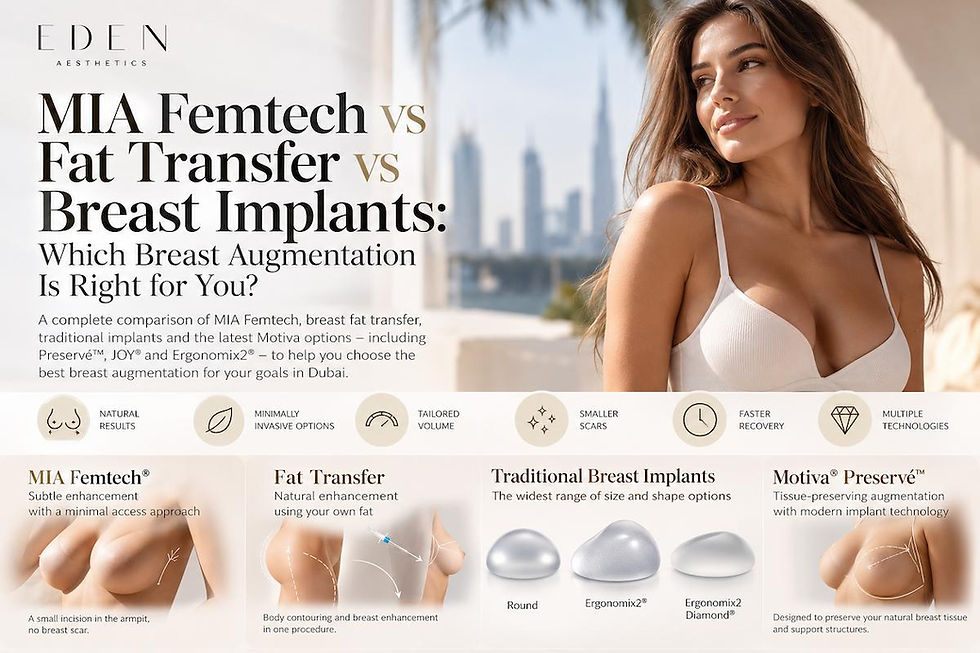
MIA Femtech vs Fat Transfer vs Breast Implants: Quick Comparison
MIA Femtech: designed for subtle, proportional implant-based enhancement through a minimal-access concept.
Fat transfer breast augmentation: uses your own fat and avoids a breast implant, but retained volume is less predictable.
Motiva Preservé™: a tissue-preserving implant technique that aims to reduce tissue disruption while allowing broader implant-volume choices than MIA.
Traditional breast implants: offer the widest range of sizes, projections and reshaping options.
1. How Much Bigger Can You Go?
For many patients, this is the question that determines the entire treatment pathway. “One cup size” sounds simple, but bra cup sizing is not standardized. A better consultation looks at breast width, skin envelope, existing tissue, implant volume in cubic centimetres, projection, symmetry and the overall proportions of the chest.
MIA Femtech: designed for subtle enhancement
MIA Femtech is built around a different idea from conventional augmentation: breast harmonization rather than a dramatic size change. The system uses the specially designed Ergonomix2 Diamond® implant and a minimal-access approach. It is most relevant when the goal is a refined, proportional increase rather than maximum volume.
Patients seeking a very large change, major reshaping or correction of significant breast ptosis may need a different operation. For those patients, conventional implant augmentation, Preservé™ where appropriate, or augmentation combined with a breast lift may offer more flexibility.
Fat transfer: the result depends on donor fat and fat survival
Autologous fat transfer — also called breast fat grafting or lipofilling — uses fat harvested by liposuction from another area of the body. The fat is processed and carefully injected into the breasts. This avoids a permanent breast implant, but not every transferred fat cell survives.
Recent systematic reviews show that a meaningful portion of transferred fat is typically resorbed during healing, which means the amount injected is not the same as the volume that remains long term. This makes fat transfer especially attractive for natural, moderate enhancement and contour refinement, but less exact when a patient has a very specific volume target.
A second session can sometimes be considered when additional volume is desired and the anatomy allows it.
Traditional implants: the widest range of volume and shape
Conventional breast augmentation offers the broadest selection of implant sizes, projections and surgical planes. This is particularly useful when a patient wants a larger increase, stronger upper-pole fullness, more precise shape control or a combined procedure such as augmentation with a breast lift.
Preservé™: a modern tissue-preserving implant option
Motiva Preservé™ is not an implant name. It is a tissue-preserving breast augmentation technique used with Ergonomix2® implants. The concept is to preserve supportive breast structures and reduce tissue disruption compared with more traditional pocket creation.
For patients comparing modern breast augmentation options, Preservé can therefore be discussed as a distinct technique: it still uses an implant, but aims to combine predictable implant volume with a less disruptive surgical approach in suitable patients.
2. Which Option Leaves the Smallest Scar?
Scar anxiety is one of the strongest reasons patients search for MIA Femtech, fat transfer or “scarless breast augmentation.” No surgical breast augmentation is literally scarless. The more useful questions are how long the incision is, where it is placed and how visible it is after healing.
MIA Femtech: a small access incision is typically placed in the axilla, so there is no conventional incision on the breast itself. An underarm scar still exists.
Fat transfer: the breast receives small cannula entry points, but there are also liposuction access sites at the donor areas.
Preservé™: generally uses a small inframammary access incision, positioned in or close to the breast fold.
Traditional implants: commonly use an inframammary incision, with exact length depending on implant, technique and anatomy.
For patient communication, “small scar,” “hidden scar” or “discreet scar” is more accurate than “scarless.” Scar quality varies with genetics, skin tension, healing, sun exposure, smoking, infection, surgical technique and aftercare.
3. Which Looks and Feels Most Natural?
“Natural” can mean three different things: natural material, natural feel, or natural appearance. Those are not identical.
Fat transfer uses the patient’s own tissue, so the added volume is biologically her own fat once it establishes a blood supply. This can create exceptionally soft transitions and is useful for subtle contour correction.
Modern implants can also create a very natural appearance and movement when the implant is correctly selected for the patient’s chest width, tissue thickness and aesthetic goal. Ergonomix2® implants are designed around a soft, dynamic concept intended to adapt with body position.
The most natural-looking result is therefore not determined by material alone. It depends on matching the technique to the anatomy and to what the patient actually wants.
4. MIA, Preservé, JOY and Ergonomix2: What Do the Names Actually Mean?
This is one of the most confusing areas online. Videos often mix procedure names, implant names and manufacturer programs as if they were interchangeable. They are not.
MIA Femtech® = the minimally invasive breast-enhancement system/procedure.
Ergonomix2 Diamond® = the specially designed Motiva implant associated with the MIA Femtech system.
Preservé™ = a tissue-preserving breast augmentation technique.
Ergonomix2® = a Motiva breast implant platform.
Motiva JOY® = a Motiva patient program/ecosystem built around Ergonomix2 implant technology, digital support and warranty elements.
What is Motiva JOY®?
Motiva JOY® is not a separate surgical method and it is not the implant itself. If you hear “JOY implants” in a video, the more precise question is usually which Ergonomix2 implant is being used and with which surgical technique.
What is Ergonomix2®?
Ergonomix2® is Motiva’s next-generation implant platform. Motiva highlights technologies including SmoothSilk®, ProgressiveGel Ultima®, TrueMonobloc+®, BluSeal+® and RFID-enabled identification technology. These are implant features and should not be confused with the name of the surgical procedure.
What is Ergonomix2 Diamond®?
Ergonomix2 Diamond® is the specially designed implant associated with the MIA Femtech system. Its design supports the small-access MIA pathway and the treatment’s intentionally subtle positioning.
5. MIA Femtech vs Fat Transfer: Which Is Better for a Small, Natural Increase?
This is one of the most relevant head-to-head comparisons for women who want a subtle result. MIA offers more predictable implant volume and does not require donor fat. Fat transfer avoids a breast implant and can simultaneously improve another body area through liposuction.
The trade-off is that fat retention is variable and the final volume cannot be predicted with the same precision as an implant. For a patient who says, “I want a small, natural increase but I do not want any implant,” fat transfer may be the more relevant discussion. For a very slim patient who wants subtle but predictable volume, MIA may be more relevant if her anatomy and medical assessment are suitable.
6. Fat Transfer vs Breast Implants: What Changes the Decision?
Implants control volume more precisely because the surgeon selects a defined implant volume, footprint and projection.
Fat transfer can refine contour very elegantly and soften transitions using the patient’s own tissue.
Fat transfer requires sufficient donor fat; very lean patients may not have enough for the desired increase.
Fat transfer adds liposuction recovery, so donor areas can determine the real downtime.
Implants remain medical devices and require long-term awareness, surveillance and the possibility of future revision.
Fat transfer may require more than one session when a larger increase is desired or initial retained volume is lower than hoped.
7. Which Option Has the Fastest Recovery?
Recovery cannot be reduced to a single number. The surgeon’s technique, implant plane, anesthesia, tissue trauma, amount of liposuction and the patient’s healing all matter.
MIA was specifically developed around a minimal-access, tissue-preserving concept and is positioned around short procedure time and relatively fast return to normal daily activities in suitable patients. Preservé also aims to reduce tissue disruption compared with traditional augmentation.
Fat transfer avoids implant-pocket surgery but adds liposuction. A patient may feel relatively comfortable in the breast while still having bruising, swelling or tenderness in the abdomen, flanks or thighs.
Practical point: do not compare recovery by breast pain alone. With fat transfer, the donor area can be the part that determines how quickly you feel fully mobile and comfortable.
8. Which Breast Augmentation Is Best If You Are Very Slim?
Very slim women can be limited candidates for stand-alone fat transfer simply because there may not be enough donor fat to harvest safely and efficiently. This does not automatically make fat transfer impossible, but the available donor volume must be compared with the desired breast increase.
If the patient wants a subtle increase and accepts an implant, MIA can become particularly relevant. If she wants more substantial volume, a conventional implant or another modern implant-based technique may provide greater flexibility.

9. What If You Want Two or More Cup Sizes?
The larger the desired change, the more important it becomes to move away from marketing labels and toward measurements. Chest width, tissue stretch, nipple position, skin quality and implant dimensions are more reliable than cup-size language.
MIA is designed around a subtle, proportional result. Fat transfer is also usually used for modest increases per session because the breast can accept only a limited graft volume safely and because some transferred fat will be resorbed.
When the goal is a more substantial increase, conventional breast augmentation — or a modern implant-based approach such as Preservé when suitable — generally provides a wider range of implant volumes and projections. If sagging is significant, a breast lift may also need to be discussed.
10. Can Breast Implants and Fat Transfer Be Combined?
Yes. Hybrid breast augmentation combines an implant with autologous fat grafting. The implant provides predictable core volume and projection; fat can then be used selectively to soften transitions, improve cleavage, camouflage implant edges or refine asymmetry.
This can be particularly useful in selected thin patients with limited soft-tissue coverage or when a very soft transition is a priority.
11. Risks and Long-Term Considerations
Every option has a different risk profile. “Less invasive” does not mean “risk-free,” and “natural” does not mean “without complications.”
Implant-based procedures can involve infection, bleeding, asymmetry, implant malposition, capsular contracture, sensory changes and device-related complications. Implants are not lifetime devices.
Fat transfer can involve fat necrosis, oil cysts, calcifications, contour irregularity, asymmetry or under-correction. Some transferred volume is normally resorbed.
Traditional implant surgery carries implant-related risks plus risks related to the chosen surgical approach and anesthesia.
Preservé remains an implant procedure despite its tissue-preserving philosophy, so long-term implant follow-up remains relevant.
12. Which Option Fits Which Goal?
“I want a subtle, proportional increase and minimal disruption.” → Discuss MIA Femtech and, depending on anatomy, Preservé.
“I do not want a breast implant.” → Discuss autologous fat transfer.
“I want the largest choice of size and projection.” → Discuss traditional implant augmentation and suitable modern implant techniques.
“I am very slim and have little donor fat.” → Implant-based options may be more practical than fat transfer alone.
“I want liposuction and breast enhancement together.” → Fat transfer breast augmentation may be especially relevant.
“I want predictable volume but very soft transitions.” → Discuss hybrid implant plus fat transfer.
“My breasts sag after pregnancy or weight loss.” → A breast-lift assessment may be required, with or without implant or fat transfer.
13. How We Approach Breast Augmentation at EDEN AESTHETICS Clinic Dubai
The strongest breast augmentation plan starts with the patient’s anatomy and goal — not with a product name. During consultation, the surgeon should evaluate breast width, existing tissue, skin elasticity, nipple position, asymmetry, chest-wall anatomy, donor-fat availability, preferred size increase, scar tolerance and lifestyle.
For some women, the right discussion may be MIA Femtech. For others, it may be fat transfer, Preservé, traditional breast implants, hybrid augmentation or a breast lift. The objective is not to force every patient into the newest technique; it is to select the technique that best matches the desired result and anatomy.
For a detailed explanation of the MIA procedure itself, see our existing EDEN guide: https://www.edenderma.com/post/mia-breast-augmentation-mia-femtech-in-dubai-the-modern-approach-to-natural-breast-enhancement
For breast augmentation consultations in Dubai, visit: https://www.edenderma.com/breast-augmentation-implants-in-dubai
Frequently Asked Questions about MIA Femtech
Is MIA Femtech the same as a normal breast implant operation?
No. MIA Femtech is implant-based, but it is a specific minimal-access breast-enhancement system using the Ergonomix2 Diamond® implant. It is designed around subtle breast harmonization rather than the full range of conventional implant augmentation.
Is MIA Femtech an implant?
MIA Femtech is the name of the procedure/system. The breast is enhanced with an implant; the specially designed implant associated with the MIA system is Ergonomix2 Diamond®.
What is the difference between MIA Femtech and Preservé?
Both are modern implant-based approaches within the Motiva/Establishment Labs ecosystem, but they are different procedures. MIA focuses on minimal access and subtle breast harmonization. Preservé is a tissue-preserving augmentation technique using Ergonomix2® implants and offers a broader augmentation concept.
What is Motiva JOY?
Motiva JOY® is a patient program, not a surgical technique. It is built around Ergonomix2® implant technology together with digital, warranty and patient-support elements.
Which looks more natural: MIA or fat transfer?
Both can look natural for different reasons. Fat transfer uses the patient’s own tissue; MIA uses an implant but is designed for a subtle, proportional result. Anatomy, volume, tissue coverage and surgical technique are often more important than the label of the procedure.
How much bigger can breasts get with fat transfer?
Fat transfer is usually best for modest enhancement. The amount depends on donor fat, breast capacity and graft survival. Because some transferred fat is resorbed, injected volume should not be treated as guaranteed final volume.
Does breast fat transfer last permanently?
Fat cells that successfully establish a blood supply can remain long term, but some transferred volume is normally resorbed during healing. Surviving fat also behaves like other body fat and can change with significant weight gain or loss.
Can very slim women have fat-transfer breast augmentation?
Sometimes, but it depends on whether enough donor fat can be harvested from areas such as the abdomen, flanks or thighs. Very lean patients may have insufficient donor volume for the breast increase they want.
Which breast augmentation leaves the smallest scar?
MIA typically uses a small axillary access incision and avoids a conventional breast-fold incision. Fat transfer uses small cannula access points but also requires liposuction access sites. Preservé and traditional implants usually use an inframammary incision, with exact length depending on technique and implant.
Can breast augmentation be done without general anesthesia?
Some modern approaches, including MIA, are designed to be possible without general anesthesia in suitable patients. The safest anesthesia plan depends on the patient, procedure, surgeon, facility and local protocol.
Which breast augmentation has the fastest recovery?
MIA and tissue-preserving approaches are designed to reduce surgical disruption, but recovery is individual. Fat transfer may involve less breast-pocket surgery yet liposuction donor areas can add bruising and recovery. Conventional implant surgery can require more recovery when greater dissection is needed.
Can I combine breast implants with fat transfer?
Yes. Hybrid breast augmentation uses an implant for predictable volume and fat grafting for contour refinement and soft-tissue coverage. It can be particularly useful in selected thin patients or when a softer transition is desired.
Do breast implants need to be replaced every ten years?
There is no universal rule that every breast implant must be replaced exactly at ten years. Implants are not lifetime devices, however, and future imaging, clinical follow-up or revision may be needed depending on the device, symptoms, findings and patient preference.
What is the best breast augmentation option after pregnancy or weight loss?
It depends on whether the main issue is lost volume, stretched skin or true breast ptosis. A patient with significant sagging may need a breast lift; adding MIA, a conventional implant or fat transfer cannot always correct excess skin on its own.
Final Takeaway
MIA Femtech, fat transfer and traditional breast implants solve different problems. MIA is built around subtle, predictable implant-based enhancement with minimal access. Fat transfer offers augmentation with your own tissue plus a body-contouring benefit, but with more variable retained volume. Traditional implants provide the greatest flexibility in size and shape. Preservé adds a newer tissue-preserving implant technique, while JOY and Ergonomix2 refer to Motiva’s program and implant technology rather than separate competing operations.
The most useful consultation begins with the result you want — not with the name of the treatment. Once your surgeon understands the desired volume, shape, scar preference, recovery priorities and anatomy, the options become much easier to compare.
Considering breast augmentation in Dubai? Book a consultation at EDEN AESTHETICS Clinic to compare MIA Femtech, fat transfer, modern Motiva options and traditional breast augmentation based on your anatomy and desired result.
Medical note: This article is educational and does not replace an individual consultation. Surgical suitability, implant availability, anesthesia, incision choice and expected recovery must be determined by the treating plastic surgeon.